How to Stop Overthinking: 7 Actionable Psychological Techniques
Break the cycle of rumination. Learn why your brain overthinks, identify analysis paralysis, and master 7 actionable psychological techniques to calm your mind.
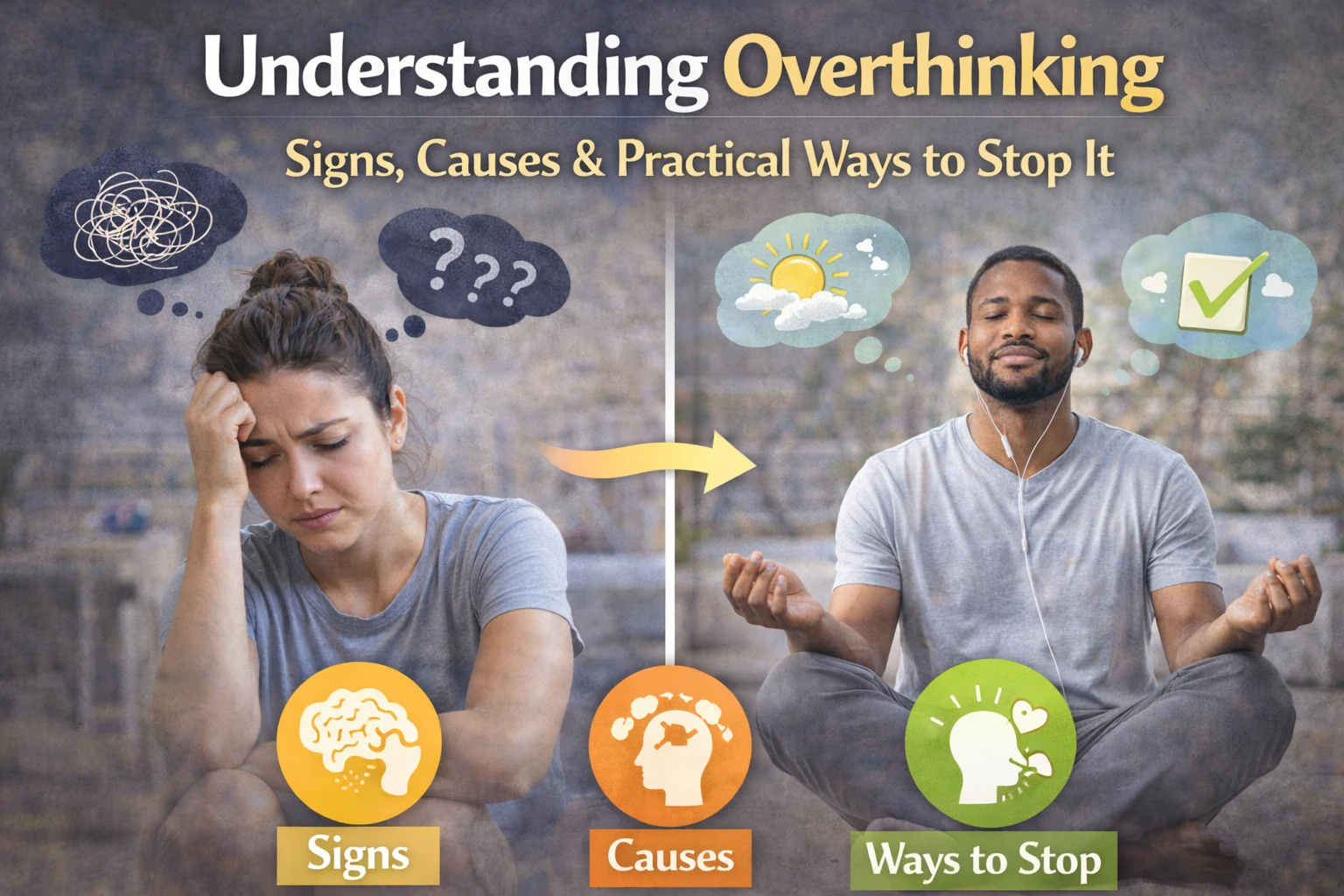
What is Overthinking? (The Psychology of Rumination)
Overthinking is not simply having a lot of thoughts—it is a repetitive, unproductive cognitive loop known clinically as rumination.
When you overthink, your brain repeatedly replays past events ('Why did I say that?') or creates catastrophic future scenarios ('What if everything falls apart?'), without ever moving toward a constructive resolution.
Psychologists classify overthinking into two primary patterns: rumination (dwelling on past mistakes or distress) and anticipatory worry (futuristic catastrophic forecasting). Recognizing which loop you are in is the essential first step toward breaking it.
Recognizing the Physical and Cognitive Signs of Overthinking
- Constant Second-Guessing: Re-analyzing decisions you have already made and searching endlessly for hidden mistakes.
- Analysis Paralysis: Struggling to make even simple daily choices due to fear of making the wrong decision.
- Mental & Somatic Exhaustion: Feeling depleted from racing thoughts, often accompanied by jaw clenching, tight shoulders, and tension headaches.
- Sleep-Disrupting Rumination: Difficulty falling asleep because your brain begins running worst-case scenarios the moment lights go out.
Why Does the Brain Overthink? (The Rumination Loop & Amygdala)
Overthinking is an evolutionary survival mechanism that becomes maladaptive in modern life. Your brain's amygdala interprets emotional uncertainty as a physical threat, prompting your prefrontal cortex to search for certainty through compulsive thinking.
Unfortunately, thinking cannot solve problems that were generated by overthinking. The more you analyze an uncontrollable situation, the more catastrophic scenarios your mind manufactures to protect you, creating a self-reinforcing neural anxiety loop.
7 Actionable Psychological Steps to Stop Overthinking
- Name the cognitive loop: Say aloud or silently, 'My brain is ruminating right now.' Labeling creates psychological distance between yourself and the thought.
- Schedule dedicated 15-minute 'Worry Time': Confine overthinking to a set afternoon window. If a repetitive thought arises outside that window, postpone it.
- Apply the 5-minute physical interrupt: Shift your nervous system state through physical movement, splashing cold water on your face, or changing rooms.
- Differentiate solvable problems from hypothetical worries: Ask: 'Is there a concrete, actionable step I can take right now?' If not, drop the mental analysis.
- Challenge automatic cognitive distortions: Ask: 'What is the objective evidence for this worst-case scenario, and what is the most realistic outcome?'
- Anchor your attention into somatic sensations: Practice box breathing or the 5-4-3-2-1 sensory grounding exercise to quiet the brain's Default Mode Network.
- Take micro-action: Inaction fuels rumination. Taking one small, imperfect physical action breaks decision paralysis immediately.
5-Minute Cognitive Interrupt Exercise
When your thoughts begin spiraling out of control, logic alone rarely halts the momentum because your nervous system is physiologically agitated. Use this rapid 5-minute somatic interrupt:
Step 1: Pause and plant both feet firmly flat on the floor. Step 2: Take four slow box breaths (inhale 4 seconds, hold 4, exhale 4, hold 4). Step 3: Name aloud 3 physical objects around you. Step 4: Write down your single biggest worry on paper and close the notebook.
This sensory redirection communicates directly to your limbic system that you are physically safe in the present moment.
When Overthinking Signals Underlying Anxiety
Occasional overthinking around significant life changes is completely normal. However, when rumination becomes chronic, daily, and uncontrollable, it may indicate Generalized Anxiety Disorder (GAD).
If persistent worry is disrupting your sleep, work, or relationships, taking an objective self-assessment or speaking with a licensed mental health professional can provide structured, personalized coping tools.
FAQs
Why do people overthink at night in bed?
At night, external distractions and tasks disappear, leaving the brain's Default Mode Network (DMN) unchecked. Fatigue also reduces your prefrontal cortex's ability to inhibit automatic worry loops. A structured evening wind-down routine helps prevent this.
What is the difference between problem-solving and overthinking?
Problem-solving is solution-oriented, time-limited, and leads to action. Overthinking is problem-oriented, endless, emotionally draining, and leads to paralysis.
Can mindfulness stop overthinking?
Mindfulness trains you to observe thoughts without identifying with them. Through cognitive defusion, you learn that thoughts are temporary mental events, not absolute facts or commands.