Thought Stopping: Interrupting Unhelpful Thoughts
A practical guide to the thought-stopping technique — how to interrupt persistent negative thoughts, reclaim attention, and practice healthier thinking patterns. Includes step-by-step scripts, examples, exercises, cautions, and therapist tips.
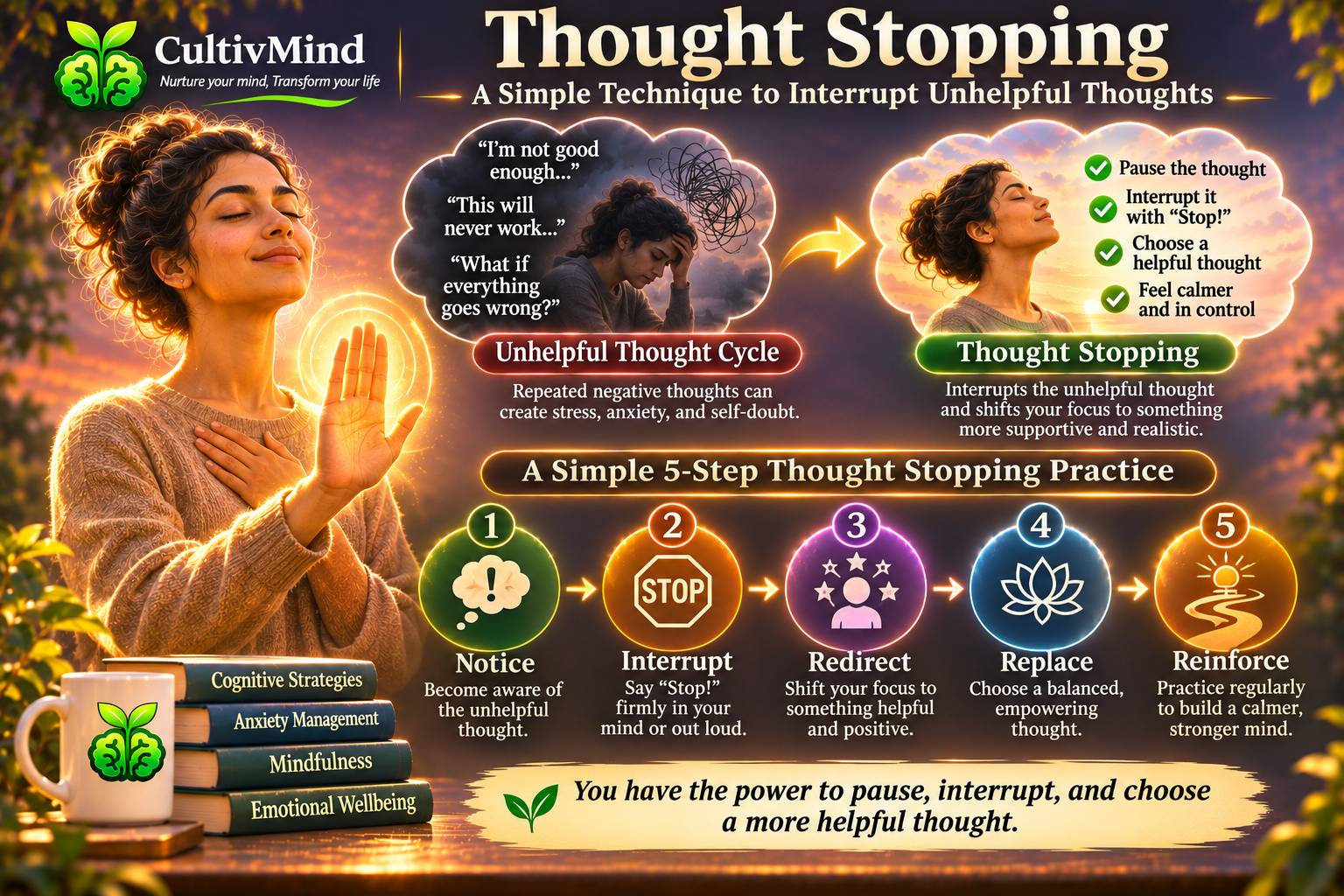
A gentle, bright illustration symbolizing mental clarity.
What is Thought Stopping?
Thought stopping is a cognitive-behavioural technique designed to interrupt repetitive, intrusive, or distressing thoughts.
The basic idea is to notice the thought, stop it deliberately, and then redirect attention to a neutral or positive task. When practiced consistently, it helps weaken the habit of rumination.
When It’s Useful
- •Short-term relief: Useful for breaking cycles of rumination or panic when immediate reduction of thought intensity is needed.
- •Pair with other strategies: Most effective when combined with cognitive strategies (reframing), behavioral experiments, or relaxation techniques.
- •Not a standalone cure: Better as a tool in a broader CBT plan—especially when thoughts are rooted in trauma or deep-seated beliefs.
Clinical Rationale
Thought stopping acts on conditioned cognitive loops: repeated intrusive thoughts become automatic. Interrupting them adds a new response (stop + redirect) that can reduce automaticity.
Therapists often teach it alongside skills that replace the stopped thought (e.g., mindfulness, problem-solving, or positive imagery).
How to Do Thought Stopping — Step-by-step
- Notice the thought: Recognize when a specific repetitive thought begins.
- Label it briefly: Name it (e.g., 'worry about rejection').
- Use a clear interrupt: Say 'Stop' aloud or in your head, snap a rubber band on your wrist, or imagine a red stop sign — choose one consistent cue.
- Replace the thought: Immediately shift to a planned alternative (deep breathing, a grounding exercise, a brief problem-solving step, or a neutral task).
- Practice and review: Repeat when the thought recurs and track how often the thought reduces over days/weeks.
Useful Replacement Strategies
- •Grounding: 5–4–3–2–1 sensory exercise to bring attention to present sensations.
- •Breathing: A 4-4-4 box breathing or 4-7-8 breathing pattern for physiological calming.
- •Task-focused: Switch to a small, engaging activity (e.g., a 2-minute physical task, count backwards from 100 by 7s, or name 10 animals).
- •Positive imagery: Briefly imagine a calm, safe place for 20–30 seconds.
Worked Example
Intrusive thought: 'I always mess up presentations.'
Thought-stopping sequence:
- Notice & label: 'presentation worry'.
- Interrupt: Say 'Stop' silently and snap a rubber band.
- Replace: Perform 30 seconds of deep breathing, then list 3 concrete past presentation successes.
- Review: Record whether worry intensity changed (0–10 scale).
Practical Exercises
1) Cue practice: Over 2 weeks, pick one interrupt cue and use it every time a target thought appears. Log frequency and intensity pre/post interruption.
2) Replacement toolkit: Build a 3-item replacement list (grounding, task, imagery) and practice each daily so switching becomes automatic.
3) Fade the cue: Once interruptions reduce thought intensity, gradually rely less on physical cues and more on brief self-instruction.
Cautions & When to Avoid
Thought stopping can be helpful short-term, but pushing away thoughts without processing them can sometimes increase rebound in some people. Use it as a temporary interrupt and pair with processing strategies (restructuring, problem-solving, therapy).
If intrusive thoughts are severe, persistent, or linked to trauma or self-harm, seek professional care rather than relying solely on thought stopping.
Therapist Tips
Teach thought stopping as one of several skills; emphasize replacement and processing.
Use behavioral experiments to show that thoughts are not facts and that interruption + review reduces intensity.
Track with simple logs to show clients progress and to decide when to fade the cue.
FAQs
Frequently Asked Questions
Does thought stopping work for OCD?
Thought stopping alone is not the recommended first-line treatment for OCD. ERP (exposure and response prevention) and clinician-guided CBT have stronger evidence. Thought stopping may be used as a temporary aid under clinical guidance.
Will stopping thoughts make them come back stronger?
For some people, suppressing thoughts without replacement can cause a rebound. That’s why replacement strategies and processing are important adjuncts.
How long to practice before noticing improvement?
Many people notice reduced intensity within days if the technique is used regularly; sustained change usually needs weeks of consistent practice and complementary therapies when needed.
Ready to put this into practice?
Follow a structured guided plan to strengthen your mental wellness habits.
Continue Reading & Exploring
Understanding Your Thoughts: Manage Negative Thinking & Thought Traps
You have tens of thousands of thoughts daily, but thoughts are hypotheses, not facts. Learn to observe mental chatter without becoming entangled.
Understanding Overthinking: Signs, Causes & Practical Ways to Break Free
Overthinking disguises itself as preparation while paralyzing action and stealing peace. Learn the 'thought postponement' technique and present grounding.
Understanding the Mind & Mental Health: How Your Brain Thinks & Feels
Demystify how subconscious conditioning, evolutionary threat sensors, and conscious awareness interact to shape your daily emotional reality.