Decatastrophize: Turning 'Worst-Case' Thoughts into Manageable Steps
Learn how to decatastrophize — an evidence-based cognitive technique for testing extreme predictions, reducing panic, and regaining control. Practical scripts, step-by-step exercises, clinician notes, and real examples included.
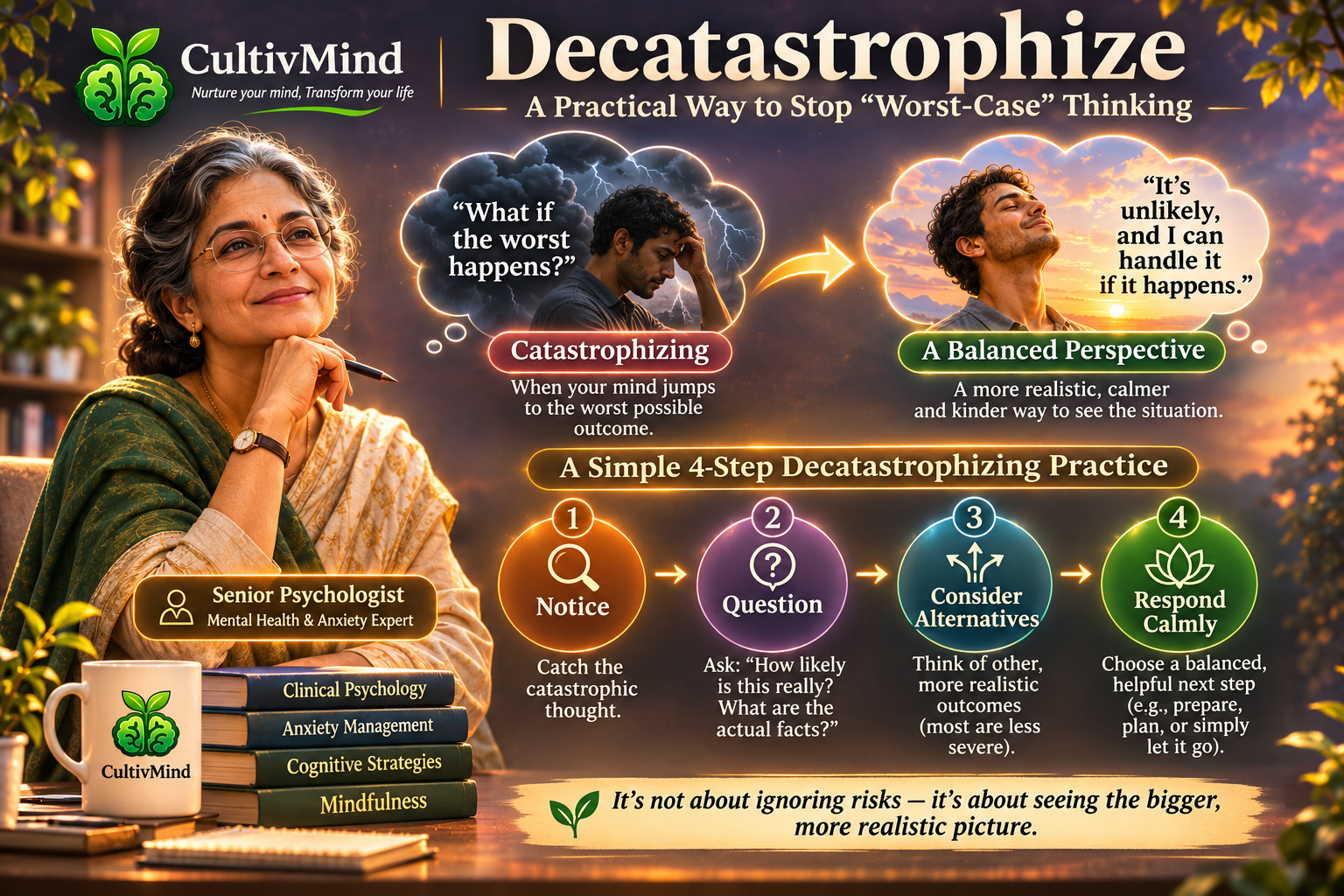
What is Decatastrophizing?
Decatastrophizing is a cognitive strategy that helps you examine and reduce catastrophic thinking — the habit of assuming the worst possible outcome will occur.
It’s widely used in cognitive-behavioural therapy (CBT) to transform exaggerated fears into realistic appraisals and actionable plans.
Why It Helps
- •Reduces Panic: By breaking large feared outcomes into smaller, more realistic probabilities, physiological arousal tends to decrease.
- •Improves Decision Making: Less catastrophic thinking means you can choose practical actions instead of avoidance.
- •Restores Agency: When fears are deconstructed into steps, you gain a clearer sense of what you can control and influence.
- •Supports Gradual Exposure: Decatastrophizing creates safer, testable steps that feed into behavioural experiments and exposure work.
Clinical Rationale (How Therapists Use It)
Therapists frame decatastrophizing as hypothesis-testing: the catastrophic thought is treated as a hypothesis to be examined — not a fact.
They guide patients to estimate probabilities, list evidence, create graded behavioural experiments, and update beliefs based on outcomes.
Step-by-step Decatastrophize Script
- Identify the catastrophic thought and write it down (e.g., 'If I fail this task, I will lose everything').
- Ask: 'Exactly what is the worst-case outcome?' Describe the worst-case specifically.
- Estimate probability: On a 0–100% scale, how likely is each part of that worst-case actually? Be honest.
- List mitigating factors: What would prevent the worst-case or reduce its impact?
- Create a most-likely scenario: What realistically is most likely to happen instead?
- Plan small, testable steps that would reduce risk or gather information (behavioural experiments).
- Decide on a coping plan if the feared outcome happens (practical, not catastrophic).
Worked Example (Short)
Catastrophic thought: 'If I ask a question in the meeting, I'll embarrass myself and be seen as incompetent, and then I'll get fired.'
Decatastrophizing steps:
- Worst-case: Manager thinks I'm incompetent → written warning → fired within 3 months.
- Probability estimate: Manager thinking negatively (30%), written warning (5%), fired (1%).
- Mitigating factors: Past positive feedback, colleagues supportive, performance metrics strong.
- Most-likely scenario: Manager may not notice, or gives gentle correction without major consequence.
- Small test: Ask one brief question in a small meeting and observe response.
Practical Exercises
1) Probability Practice: For one week, note one catastrophic thought per day and write a realistic probability (0–100%) next to each feared outcome. Review outcomes after 1–2 weeks.
2) Graded Exposure Planning: Convert a catastrophic thought into 5 graded steps (lowest to highest intensity). Attempt step 1, record outcomes, then progress only if manageable.
3) Coping Plan Prep: For each catastrophic scenario you imagine, write 2–3 concrete actions you would take if it occurred (who to call, what steps to follow).
Scripts & Prompts to Use Immediately
- •Prompt 1: 'What’s the worst thing that could realistically happen, step by step?'
- •Prompt 2: 'What’s the probability each piece of that worst-case will actually occur?'
- •Prompt 3: 'If the worst did happen, what would be my first practical step? Who could help?'
When Decatastrophizing May Fall Short
If catastrophic beliefs are rooted in trauma, persistent panic, or severe mood problems, decatastrophizing alone may not be enough. Combine it with trauma-informed therapy, medication when indicated, or specialist care.
Also, attempts to ‘reason away’ fear while arousal is very high can be hard — pairing cognitive work with grounding and relaxation often helps.
Supporting Habits
- •Arousal Management: Practice breathing and grounding before heavy cognitive work to lower reactivity.
- •Sleep & Nutrition: Stable physiology supports clearer risk estimates and reduces bias toward catastrophizing.
- •Social Feedback: Trusted colleagues or friends can provide reality-based perspective and share data.
FAQs
Frequently Asked Questions
Is decatastrophizing the same as optimism?
No. Decatastrophizing seeks balanced, evidence-based conclusions, not forced optimism. It’s about accuracy and action.
How often should I practice?
Daily practice for early weeks helps — even short exercises. Lasting change takes repeated trials and real-world testing.
Can this trigger more worry?
Sometimes thinking about worst cases briefly raises anxiety; if that happens, use grounding first and proceed gently or with therapist guidance.
Ready to put this into practice?
Follow a structured guided plan to strengthen your mental wellness habits.
Continue Reading & Exploring
Anxiety: Symptoms, Causes, Types & Proven Management
Anxiety is an anticipatory state of uneasiness where the nervous system stays on high alert. Learn the symptoms, causes, and clinical tools to calm your mind.
Panic Attacks: Symptoms, Causes, Triggers & How to Stop Them
A panic attack is a sudden surge of intense fear and physical alarm. Understand why it happens and how to de-escalate acute panic in minutes.
What Is Fear? Psychology, Types & How to Overcome It
Fear is a primal biological mechanism designed to protect you, but irrational fear can restrict your life. Discover evidence-based ways to recondition fear responses.