Reality Checking for Anxiety: How & Why It Helps
Practical, evidence-informed guidance on using reality checks to test anxious predictions, reduce catastrophic thinking, and strengthen adaptive coping. Includes step-by-step exercises you can use in the moment and in therapy.
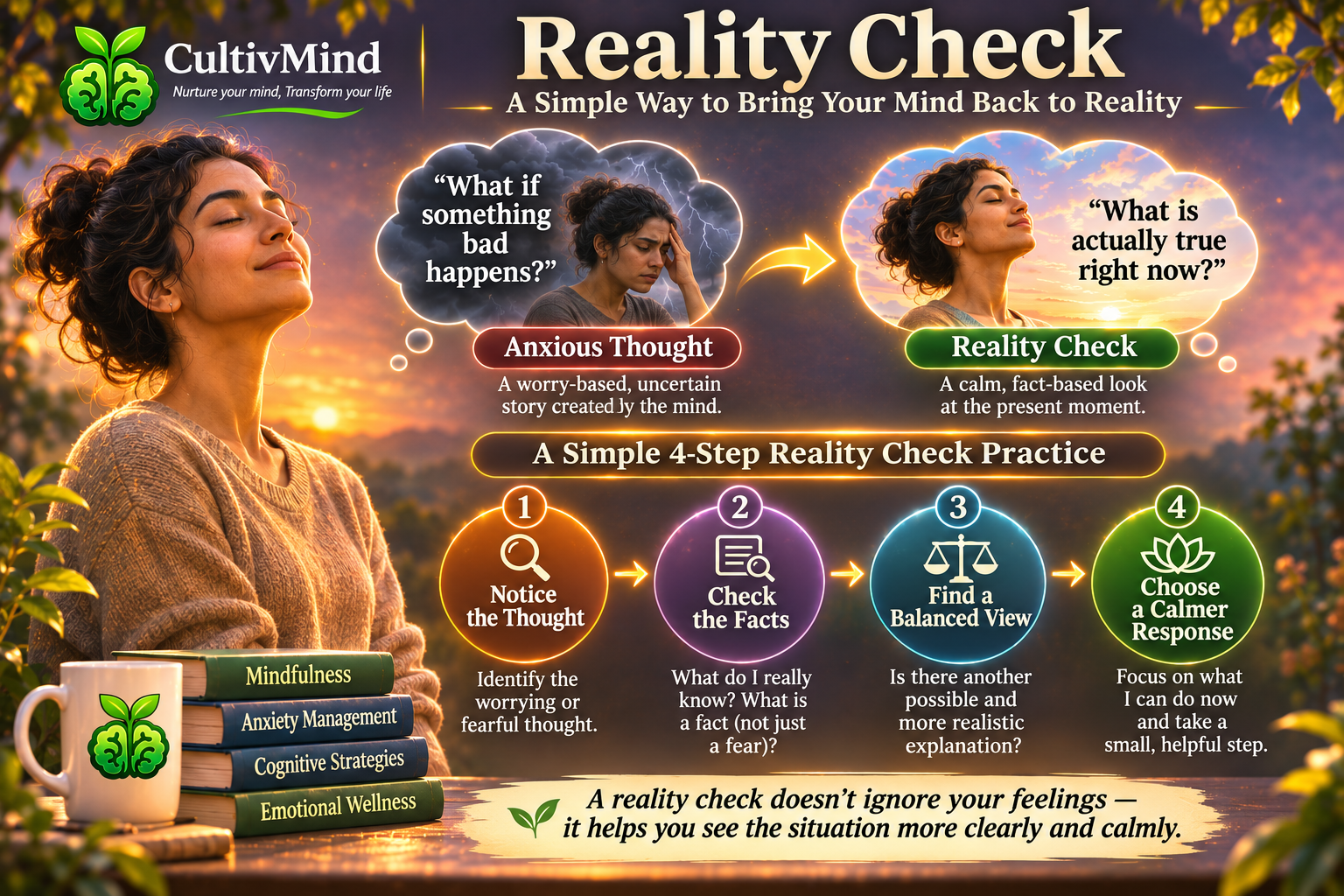
What is a Reality Check?
A reality check is a structured mental habit that helps you test anxious thoughts and predictions against observable evidence. It's a core cognitive strategy used in cognitive-behavioural therapy (CBT) and other evidence-based approaches.
Rather than accepting an anxious thought as fact, a reality check asks: 'What evidence supports this thought? What evidence contradicts it?' — and then uses the answer to shift toward balanced thinking.
Why Reality Checks Are Useful
- •Reduces Catastrophizing: They interrupt 'what if' spirals by focusing attention on present facts rather than worst-case scenarios.
- •Improves Emotional Regulation: By grounding cognition in evidence, intense anxiety often becomes more manageable and less overwhelming.
- •Builds Psychological Flexibility: Regular practice strengthens the skill of holding multiple interpretations of a situation instead of accepting the most fearful one.
- •Supports Behavioral Activation: Reality checks can reduce avoidance by clarifying the real level of risk and encouraging measured action.
How a Clinician Thinks About Reality Checking
Psychiatrists and CBT therapists view reality checking as an active experiment: a testable hypothesis about a belief (e.g., 'If I speak up, I'll be humiliated').
The clinician frames steps for the patient to gather data, test the belief in small, safe ways, and revise the belief based on outcomes.
Step-by-step Reality Check (In-the-moment)
- Pause and label the thought: Name the worry (e.g., 'I'm sure I'll say something stupid').
- Rate intensity: On a 0–10 scale, how anxious does this feel now?
- Ask evidence-for: What concrete facts support this thought right now?
- Ask evidence-against: What facts contradict or weaken it?
- Consider alternatives: What are 1–2 more balanced interpretations?
- Decide on action: What small, feasible step could test the belief?
- Review outcome: After the step, compare what actually happened to what you predicted.
Short Scripts & Prompts (Useable Anywhere)
- •Script 1: 'Is this a fact or a feeling? If it's a feeling, what evidence would change it?'
- •Script 2: 'What's the worst that could realistically happen? How likely is that outcome on a 0–100% scale?'
- •Script 3: 'If a friend said this about themselves, what would I say back?'
Practical Exercises
1) Evidence Log: For one week, write down 2–3 anxious predictions each day and record whether they happened and what the real outcome was.
2) Behavioural Experiment: Pick a low-stakes situation that triggers anxiety, predict the outcome, try it, then record what happened and how your prediction matched reality.
3) 5–4–3–2–1 Grounding paired with Reality Check: Use sensory grounding to reduce arousal, then perform the step-by-step reality check while calm.
How to Use Reality Checks in Therapy
A therapist can help you design safe experiments and process results so that belief change is supported rather than rushed.
Therapy provides structure: starting small, measuring outcomes, and scaling experiments as confidence and data accumulate.
When Reality Checks Might Not Be Enough
Reality checks are powerful for cognitive distortions and mild-to-moderate anxiety but may be insufficient alone when anxiety is severe, chronic, or rooted in trauma.
If anxiety causes frequent panic attacks, severe avoidance, suicidal thoughts, or significant functional impairment, consult a mental health professional for a comprehensive plan (therapy, medication evaluation, or combined treatment).
Healthy Habits That Support Reality Checking
- •Sleep & Rest: Poor sleep increases emotional reactivity and makes accurate evaluation harder.
- •Regular Movement: Exercise reduces baseline anxiety and makes cognitive strategies more effective.
- •Limit Stimulants: Caffeine and nicotine can amplify physical anxiety symptoms and bias the mind toward catastrophizing.
- •Social Support: Sharing predictions and outcomes with a trusted person adds reality-based feedback and encouragement.
FAQs
Frequently Asked Questions
How long before reality checks help?
You may notice immediate reductions in catastrophic thinking after a single practice, but sustained belief change usually requires repeated practice over weeks—especially for well-established anxiety patterns.
Are reality checks the same as 'positive thinking'?
No. Reality checks are not about forcing optimism; they are about testing thoughts against evidence and adopting balanced, accurate beliefs based on data.
Can reality checks make anxiety worse?
If used rigidly or punitively, they can backfire. The goal is gentle, curious testing, not self-criticism. A therapist can help tailor the approach.
Can children use reality checks?
Yes—when adapted to developmental level. For kids, use simpler language, visual evidence charts, and supervised behavioural experiments.
Ready to put this into practice?
Follow a structured guided plan to strengthen your mental wellness habits.
Continue Reading & Exploring
Anxiety: Symptoms, Causes, Types & Proven Management
Anxiety is an anticipatory state of uneasiness where the nervous system stays on high alert. Learn the symptoms, causes, and clinical tools to calm your mind.
Panic Attacks: Symptoms, Causes, Triggers & How to Stop Them
A panic attack is a sudden surge of intense fear and physical alarm. Understand why it happens and how to de-escalate acute panic in minutes.
What Is Fear? Psychology, Types & How to Overcome It
Fear is a primal biological mechanism designed to protect you, but irrational fear can restrict your life. Discover evidence-based ways to recondition fear responses.