How to Write Safety Statements for Anxiety Relief
Learn what safety statements are, why they work, and how to create powerful personal affirmations to calm anxiety, reduce panic, and regain control during stressful moments.
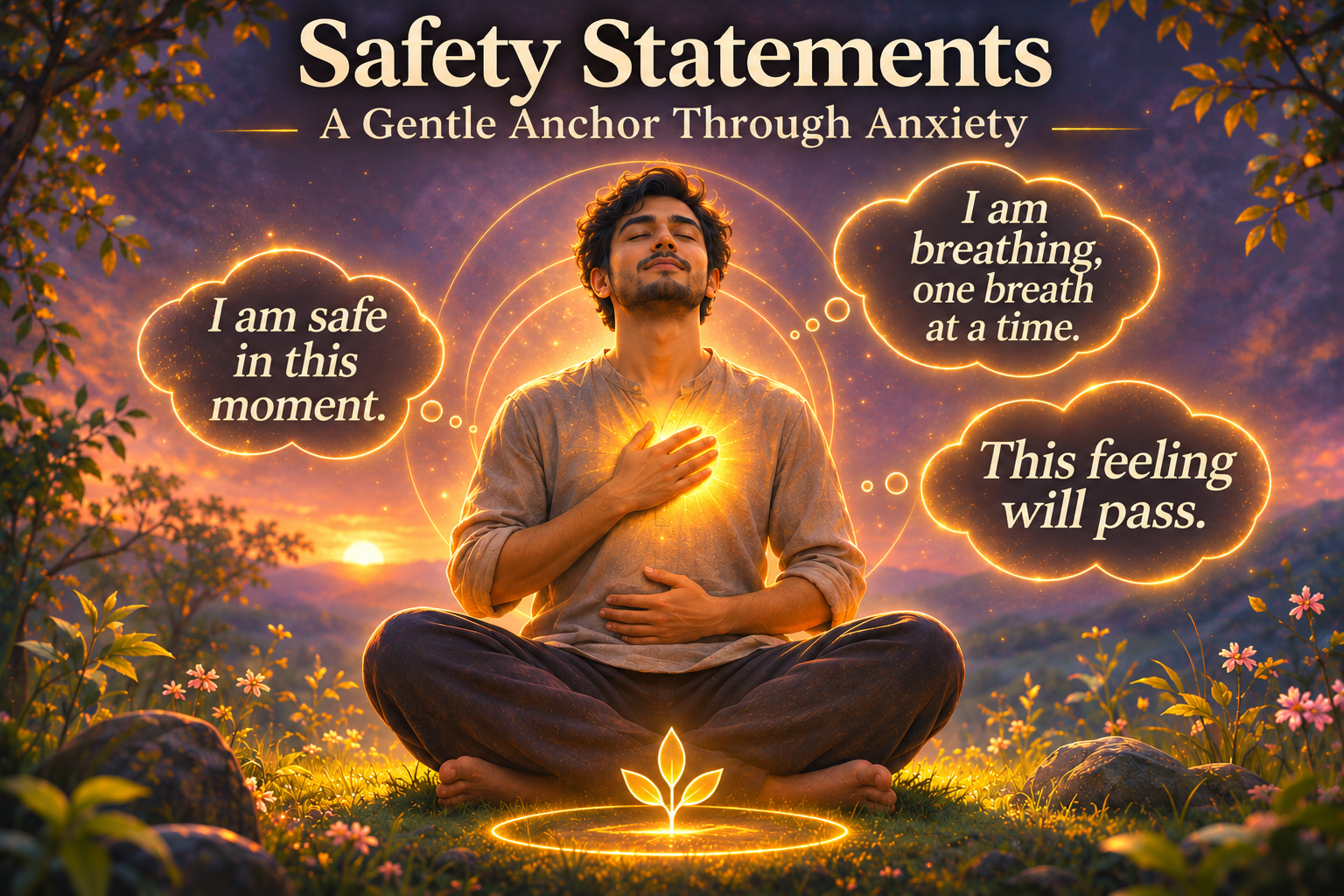
What Are Safety Statements?
Safety statements are short, positive affirmations you repeat to yourself during moments of anxiety or panic.
They act as mental anchors — reminding your brain that you are safe, capable, and in control, even when emotions feel overwhelming.
Unlike general positive thinking, safety statements are personal, realistic, and grounded in truth.
Why Safety Statements Help Reduce Anxiety
- •Interrupts Panic Cycles: Replaces catastrophic thoughts with calming, rational truths.
- •Activates the Parasympathetic System: Tells your body 'the danger has passed' — lowering heart rate and stress hormones.
- •Builds Self-Trust: Strengthens your inner voice of safety and resilience over time.
- •Portable & Instant: Can be used anywhere — no tools, apps, or preparation needed.
When to Use Safety Statements
- During a panic attack or sudden anxiety spike
- Before entering a stressful situation (e.g., meeting, flight, social event)
- When intrusive 'what if' thoughts appear
- At night when anxiety keeps you awake
- Anytime you feel disconnected from the present moment
How to Create Effective Safety Statements
Good safety statements follow the **3 R’s**: **Realistic**, **Reassuring**, and **Rephrased in the present tense**.
Avoid vague phrases like 'Everything will be okay.' Instead, use specific, believable truths.
- •Start with 'I am...': I am safe in this moment. I am breathing. I am here.
- •Use sensory grounding: My feet are on the ground. I can feel my hands. I see the room around me.
- •Acknowledge feelings + pivot: I feel anxious, and that’s okay. I’ve handled this before.
- •Affirm past success: I’ve been through hard moments and came out stronger.
Examples of Powerful Safety Statements
Here are ready-to-use statements. Pick 2–3 that feel true to you:
- I am safe right now. This feeling will pass.
- My body is reacting, but I am not in danger.
- I’ve survived every tough day so far — I will survive this one too.
- I am allowed to feel anxious. I don’t have to fight it.
- One breath at a time. I only need to get through this moment.
- I am in control of my next action.
- This is anxiety talking — not reality.
How to Practice Writing Safety Statements
Set aside 5 quiet minutes. Write 3 statements that feel true and calming to you.
Keep them in your phone, on a note, or as a lock screen reminder.
Practice saying them out loud in front of a mirror — it strengthens the neural pathway.
Update them weekly as you learn what works best.
Pro Tips for Maximum Impact
- •Say them slowly: With full attention — not rushed.
- •Pair with breathing: Inhale calm, exhale tension.
- •Use during calm moments too: Builds habit before crisis hits.
- •Write in your own words: Personalized statements are 10x more powerful.
FAQs About Safety Statements
Frequently Asked Questions
Do safety statements really work during a panic attack?
Yes — when practiced regularly. They don’t stop anxiety instantly, but they shorten the episode and prevent escalation.
What if I don’t believe the statement?
Start with neutral truths: 'I am sitting. I am breathing. I am here.' Belief grows with repetition.
How many should I write?
Start with 3. Keep the ones that resonate most. You can always add more.
Can I use them for others (e.g., kids)?
Absolutely. Teach children simple versions like: 'I am safe. Mommy/Daddy is here. I am okay.'
Ready to put this into practice?
Follow a structured guided plan to strengthen your mental wellness habits.
Continue Reading & Exploring
Anxiety: Symptoms, Causes, Types & Proven Management
Anxiety is an anticipatory state of uneasiness where the nervous system stays on high alert. Learn the symptoms, causes, and clinical tools to calm your mind.
Panic Attacks: Symptoms, Causes, Triggers & How to Stop Them
A panic attack is a sudden surge of intense fear and physical alarm. Understand why it happens and how to de-escalate acute panic in minutes.
What Is Fear? Psychology, Types & How to Overcome It
Fear is a primal biological mechanism designed to protect you, but irrational fear can restrict your life. Discover evidence-based ways to recondition fear responses.